

Ndhlovu Nkosikhona
February 18, 2026

There is something quietly profound about looking down at a place you know from the ground. From space, Haka Game Park appears as a patch of green nestled within Harare’s urban expanse, a living lung in the city’s chest. But when you compare two images, taken five years apart, the green patch tells a story. A story that human eyes on the ground might miss, but satellites see clearly.
For five years, we have asked ourselves: Is our work making a difference? Is the wetland healing? Are we on the right path?
Now we have the answer. And it is written in pixels.
This is what the satellites saw.
From hundreds of kilometres overhead, Haka Game Park reveals itself in patterns invisible at ground level. The Ramsar wetland shimmers darkly. The woodlands form textured carpets. The grasslands shift with the seasons. And the gazebos, small dots of human presence-cluster in designated areas where families gather to picnic and watch the wildlife .
In 2020, we captured a baseline. In 2025, we captured it again. The difference between those two images tells a story of restoration, resilience, and the quiet power of consistent stewardship.
The data is in, and it reveals something remarkable.
GIS in Wildlife Enthusiast
Land cover mapping uses satellite imagery to classify every pixel of a landscape into categories: water, vegetation, bare ground, built structures . By comparing two points in time, we can see exactly what has changed-down to the percentage point.
For Haka Game Park, we tracked four key classes:
Water — the lifeblood of our Ramsar wetland
Dense Vegetation/Woodland — indicator of habitat health
Grassland/Open Areas — important for grazing wildlife
Built-up Areas — primarily picnic gazebos supporting visitor access
The 2020 map established our baseline. The 2025 map showed our progress. This is not guesswork or anecdote. It is peer-review-ready data-credible, verifiable, scientific
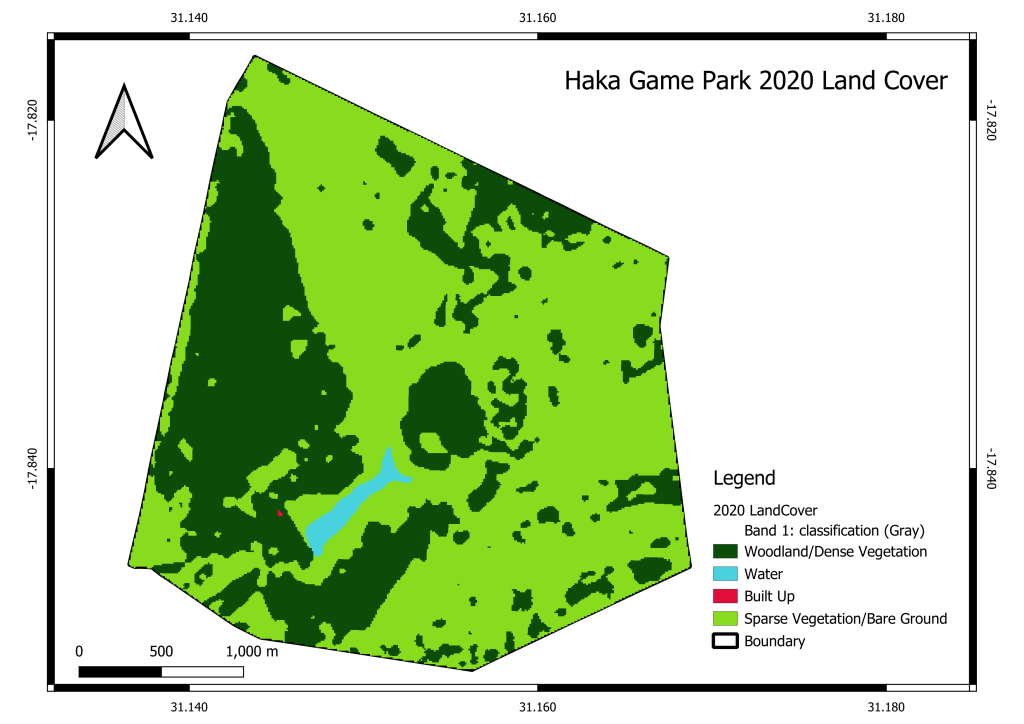
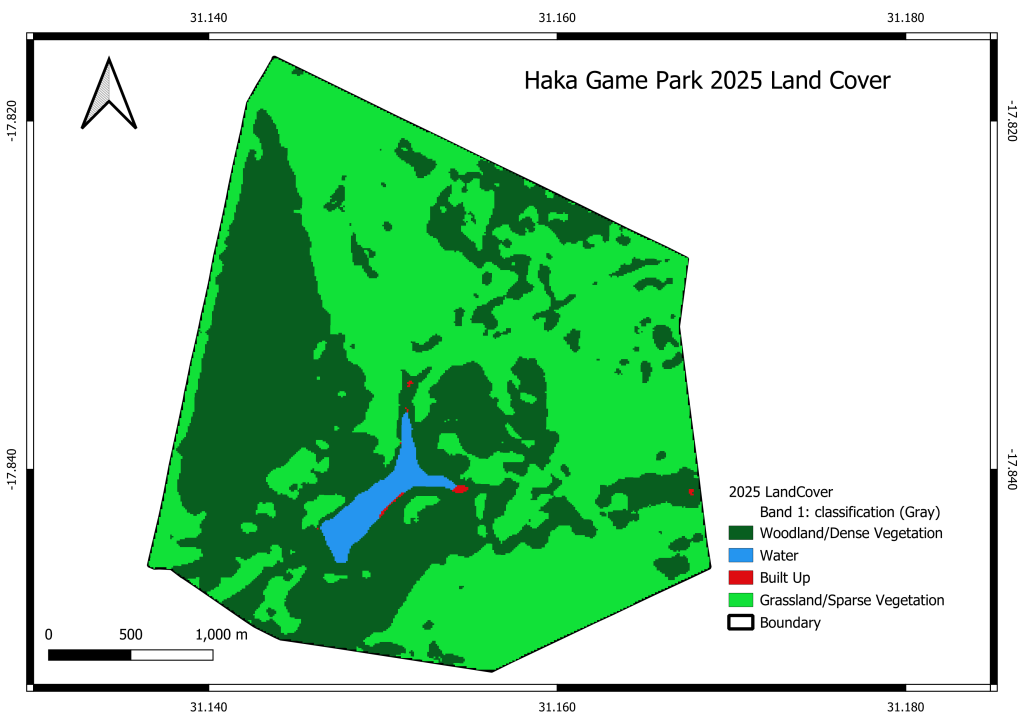
| Land Cover Class | 2020 | 2025 | Change |
|---|---|---|---|
|
Water |
1.0% |
1.9% |
+90% |
In just five years, water coverage within Haka Game Park nearly doubled. From 1% of the park’s area to 1.9%, a 90% increase .
What does this mean in real terms? More water means:
Healthier aquatic ecosystems
Increased bird populations, including migratory species that depend on wetlands
Greater resilience during dry spells
Enhanced filtration of water flowing through the park
For a Ramsar site, water extent is the fundamental metric. Wetlands designated under the Ramsar Convention are recognised as being of international importance precisely because of their ecological character . An increase in water coverage demonstrates that the site’s ecological integrity is not just maintained but improving.
This matters beyond our boundaries. Urban wetlands provide essential services: water purification, flood control, climate regulation, and biodiversity preservation . A recovering wetland in Harare’s midst benefits the entire city.
The water did not return by accident. It returned because of deliberate, sustained action.
Removal of invasive alien species: Water-hungry alien trees were systematically cleared from the wetland buffer zones, allowing natural water flow patterns to re-establish.
Active wetland management: Our team worked consistently to maintain the conditions that allow water to persist.
Protection of water sources: Development was carefully controlled in sensitive areas, preventing disruption to the hydrology that feeds the wetland.
Victoria Falls, another Zimbabwean Ramsar site recently accredited as a Wetland City, demonstrates similar principles: strict development control, mandatory replanting of indigenous trees, and continuous community engagement . Their approach mirrors ours, proof that these methods work.
The water story is dramatic, but it is not the only story.
| Land Cover Class | 2020 | 2025 | Change |
|---|---|---|---|
|
Dense Vegetation/Woodland |
38.2% |
43% |
4.8% |
Alongside the water recovery, our woodlands have expanded. Dense vegetation now covers more of the park than it did five years ago.
Why this matters:
Habitat for wildlife: Species like sable antelope, kudu, and countless birds depend on woodland cover
Soil stabilization: Tree roots hold soil in place, preventing erosion into the wetland
Carbon sequestration: Growing woodlands capture carbon, contributing to climate resilience
Wildlife corridors: Connected woodland allows animals to move safely through the park
This expansion is a direct result of invasive species clearance. By removing fast-spreading alien plants, we gave native species room to regenerate. The satellites confirm what our rangers have observed on the ground: the bush is returning, healthier than before
| Land Cover Class | 2020 | 2025 | Change |
|---|---|---|---|
|
Built-up (Gazebos) |
– |
0.3% |
0.3% |
The 2025 map also shows an increase in built-up areas-specifically, the picnic gazebos constructed around the park.
A question naturally arises: Did development harm the environment?
The data answers clearly: water and woodland increased alongside the gazebos.
This is the coexistence model in action. The gazebos serve multiple purposes:
They concentrate human activity in designated areas, reducing trampling and disturbance elsewhere
They generate revenue that funds invasive species clearance and wetland restoration
They demonstrate that people and wildlife can share space when management is thoughtful
Wetlands are not museums to be sealed away. They are living systems that can, with careful management, accommodate both ecological integrity and human presence . The Ramsar Convention’s Wetland City Accreditation scheme explicitly recognises cities that successfully balance these priorities .
The gazebos and the wetland are not competing interests. They are partners. The gazebos help fund the restoration. The restoration attracts visitors to the gazebos. It is a virtuous cycle, captured in satellite imagery.
Haka Game Park sits within Harare’s city limits. This is not a remote wilderness accessible only after days of travel. It is an urban sanctuary-a place where city residents can witness conservation in action, just minutes from their homes .
The data proves something significant: urban conservation works. You do not need vast, untouched landscapes to make a measurable difference. A 2,500-hectare park, carefully managed, can improve ecological health in just five years.
For Harare, this means:
A healthier wetland filtering water and supporting biodiversity
A carbon sink in the middle of a growing city
Accessible nature for residents who might otherwise never connect with wild spaces
A living laboratory for students and researchers
A model for other urban protected areas across Zimbabwe and Africa
As the global community recognised at Ramsar COP15 in Victoria Falls, integrating wetlands into urban design is the city of the future-more climate-resilient, more water-secure, more liveable . Haka is contributing to that future, right now.
This five-year milestone is cause for celebration. But it is not the finish line. It is a waypoint.
Our goals for 2030 include:
Continuing invasive species removal to further expand water coverage
Increasing woodland connectivity to strengthen wildlife corridors
Expanding educational programs so more schools can experience this living classroom
Enhancing visitor experience while maintaining—and improving—habitat protection
The 2025 map becomes the new baseline. The next five years will build upon it.
The water is returning. The woodlands are expanding. The model is working.
What the satellites saw was a wetland coming back to life. Not by accident. Not by wishful thinking. By consistent, patient, data-driven stewardship.
For the team at Haka Game Park, these images are more than pixels. They are validation. They are proof that the long game pays off. They are motivation to keep going.
And they are an invitation.
Numbers tell a story. But nothing compares to experiencing it firsthand.
We invite you to visit Haka Game Park and witness the wetland revival for yourself. Walk the trails where water now flows. Picnic at the gazebos that help fund this work. Watch the sunset over a Ramsar site that is healing, not declining.
| Contact | Details |
|---|---|
| Call/WhatsApp | +263 77 334 3310 |
| Location | Cleveland Dam, Mutare Road, Msasa, Harare |
| Website | hakagamepark.co.zw |
Every visit helps write the next chapter of this story. Come be part of it.
“The water did not return by accident. It returned because active management works.”
“From 1% to 1.9%—a near-doubling of water in just five years.”
“The gazebos and the wetland are not competing priorities. They are two sides of the same coin.”
“What the satellites saw was a wetland coming back to life.”

Haka Game Park
Cleveland Dam, Harare
Haka Game Park
Welcome to Haka Game Park. How can I help you today?
Hello do you have accommodation there?!
Great post,Thanks for sharing